Wednesday, February 15, 2023

High-paying jobs that don't need a college degree? Thousands of them are sitting empty

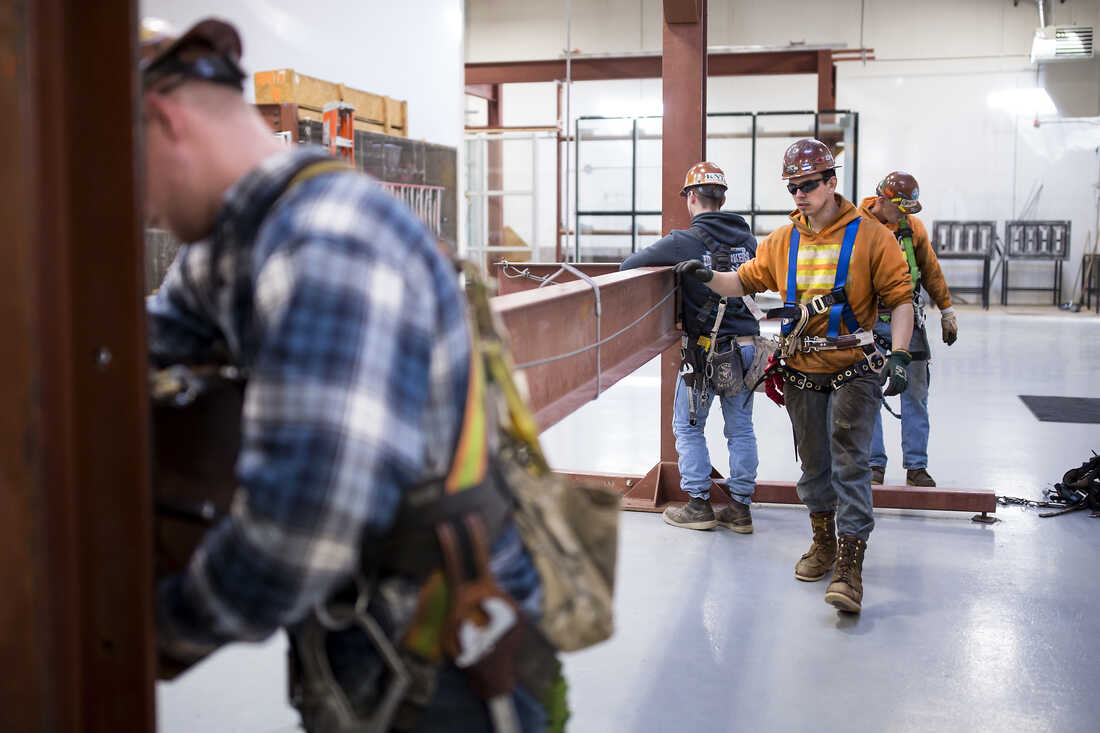
In 2018, Garret Morgan (center) was training as an ironworker near Seattle. Five years later, he says he made the right career choice: "I'm loving it every day."

Sy Bean/The Hechinger Report

Like most other American high school students, Garret Morgan had it drummed into him constantly: Go to college. Get a bachelor's degree.

"All through my life it was, 'If you don't go to college you're going to end up on the streets,' " Morgan said back in 2018. "Everybody's so gung-ho about going to college."

So he tried it for a while. Then he quit and started training as an ironworker, which is what he was doing on a weekday morning in a nondescript high-ceilinged building with a concrete floor in an industrial park near the Seattle-Tacoma International Airport.

Morgan and several other men and women were dressed in work boots and hard hats, clipped to safety harnesses with heavy wrenches hanging from their belts. They were being timed as they wrestled 600-pound I-beams into place.

Back then, the demand for ironworkers was rising – and it still is: the sector is growing 4% annually, according to the Bureau of Labor Statistics. Ironworkers earn, on average, $27.48 per hour, or $57,160 per year. Morgan was already working on a job site when he wasn't at the Pacific Northwest Ironworkers shop. At 20, he was earning $28.36 an hour, plus benefits.

Five years later, he's on the job full time, working "six-10s" — industry lingo for 10 hours a day, six days a week. He helped build the Rainier Square Tower in Seattle and a data center for Microsoft. "I'm loving it every day," he said. "It was absolutely the right choice.

As for his friends from high school? "Someday maybe they'll make as much as me."


In 2018, ironworkers practiced tying rebar at the Iron Workers Local Union #86 Administrative Offices in Tukwila, Wash.

Sy Bean/The Hechinger Report

Raising alarms

While a shortage of workers pushes wages higher in the skilled trades, the financial return from a bachelor's degree is softening, even as the price, and the average debt into which it plunges students, remain high.

But high school graduates have been so effectively encouraged to get a bachelor's that high-paid jobs requiring shorter and less expensive training are going unfilled. This affects those students and also poses a real threat to the economy.

"Parents want success for their kids," Mike Clifton, who taught machining for more than two decades at the Lake Washington Institute of Technology before retiring, said in 2018. "They get stuck on [four-year bachelor's degrees], and they're not seeing the shortage there is in tradespeople until they hire a plumber and have to write a check."

The Washington State Auditor found in 2017 that good jobs in the skilled trades were going begging because students are being almost universally steered to bachelor's degrees. Recent labor statistics suggest that's still the case – in Washington State and around the country.

President Biden, in his State of the Union address this month, spoke of "jobs paying an average of $130,000 a year, and many do not require a college degree."

Among other things, the Washington auditor recommended that career guidance — including choices that require less than four years in college — start as early as the seventh grade.

"There is an emphasis on the four-year university track" in high schools, Chris Cortines, who co-authored the report, said after it was issued. Yet, nationwide, nearly three out of 10 high school grads who go to four-year public universities haven't earned degrees within six years, the most recent figures from the National Student Clearinghouse show. At four-year private colleges, that number is nearly one in five.

"Being more aware of other types of options may be exactly what they need," Cortines said. In spite of a perception that college "is the sole path for everybody," he said, "when you look at the types of wages that apprenticeships and other career areas pay, and the fact that you do not pay four years of tuition and you're paid while you learn, these other paths really need some additional consideration."

And it's not just in Washington state.

Today, nearly 90% of construction companies nationwide are having trouble finding qualified workers, according to the Associated General Contractors of America; in Washington, the proportion is 88%. Ironworkers remain in particularly short supply, along with drywall installers and sheet metal workers.

The $1.2 trillion federal infrastructure plan – Biden's signature legislation passed by Congress in 2021 – will create 1.5 million construction jobs per year for the next 10 years, the White House says, boosting the share of all jobs that are connected with rebuilding the nation's infrastructure from 11% to 14%, according to the Georgetown University Center on Education and the Workforce. Median wages for construction jobs are higher than the median pay for all jobs, the Bureau of Labor Statistics reports.

"The economy is definitely pushing this issue to the forefront," Amy Morrison Goings, president of the Lake Washington Institute of Technology, which educates students in these fields, said in 2018. "There isn't a day that goes by that a business doesn't contact the college and ask the faculty, 'who's ready to go to work?' "

Amy Morrison Goings, president of the Lake Washington Institute of Technology, said in 2018: "There isn't a day that goes by that a business doesn't contact the college and ask the faculty who's ready to go to work."

Sy Bean/The Hechinger Report

In all, some 30 million jobs in the United States that pay an average of $55,000 per year don't require bachelor's degrees, according to the Georgetown Center on Education and the Workforce.

Yet the march to bachelor's degrees continues. And while people who get them are more likely to be employed and make more money than those who don't, that premium appears to be softening; their inflation-adjusted median earnings were lower in 2018, the most recent year for which the figure is available, than in 2010.

"There's that perception of the bachelor's degree being the American dream, the best bang for your buck," said Kate Blosveren Kreamer, deputy executive director of Advance CTE, an association of state officials who work in career and technical education. "The challenge is that in many cases it's become the fallback. People are going to college without a plan, without a career in mind, because the mindset in high school is just, 'Go to college.' "

It's not that finding a job in the trades, or even manufacturing, means needing no education after high school. Most regulators and employers require certificates, certifications or associate degrees. But those cost less and take less time than earning a bachelor's degree.

Tuition and fees for in-state students to attend a community or technical college in Washington State, for example, came to less than half the cost last year of a four-year public university, and less than a fifth of the price of attending the cheapest private four-year college.

Washington is not the only state nudging students into education for the trades. At least 39 states have taken steps to encourage career and technical education, and many have increased funding for it, a 2017 Brookings Institution review found.

At the federal level, legislation introduced in Congress in January would make some short-term workforce programs eligible for federal Pell Grants. "For too long, the college-for-all mentality drove Americans toward expensive and often ineffective education pathways," its sponsors said. "As our country stares down a historic worker shortage, fewer Americans are getting the skills they need to be successful."

The branding issue

Money isn't the only issue, advocates for career and technical education say. An even bigger challenge is convincing parents that it leads to good jobs.

"They remember 'voc-ed' from when they were in high school, which is not necessarily what they aspire to for their own kids," Kreamer said. Added Kairie Pierce, apprenticeship and college director for the Washington State Labor Council of the AFL-CIO: "It sort of has this connotation of being a dirty job. 'It's hard work — I want something better for my son or daughter.' "

Matthew Dickinson, 21, asks a classmate for help as they rebuild an automatic transmission back in 2018 in a class at the Lake Washington Institute of Technology.

Sy Bean/The Hechinger Report

The Lake Washington Institute of Technology, about 20 miles from Seattle, changed its name from Lake Washington Technical College, said Goings, its president, to avoid being stereotyped as a vocational school.

These perceptions fuel the worry that, if students are urged as early as the seventh grade to consider the trades, then low-income, first-generation students, and students of color will be channeled into blue-collar jobs while wealthier and white classmates are pushed by their parents to get bachelor's degrees.

"When CTE was vocational education, part of the reason we had a real disinvestment from the system was because we were tracking low-income and minority kids into these pathways," Kreamer said. "There is this tension between, do you want to focus on the people who would get the most benefit from these programs, and — is that tracking?"

In a quest for prestige and rankings, and to bolster real-estate values, high schools also like to emphasize the number of their graduates who go on to four-year colleges and universities.

Jessica Bruce enrolled in community college after high school for one main reason: because she was recruited to play fast-pitch softball. "I was still trying to figure out what I wanted to do with my life," she said.

But she "couldn't quite figure it out," she says today. She was an apprentice ironworker in 2018, making $32.42 an hour, or more than $60,000 a year, while continuing her training. At 5-foot-2, "I can run with the big boys," she said at the time, laughing.

Five years later, now 46, she's starting a job installing 500 tons of rebar for a Boeing hangar near Seattle, working mostly outside, which she likes. She's also back in school, of sorts, taking online courses to get her certification to become a fitness instructor as a side gig. And she's bought a Harley.

Bruce says she has "absolutely no regrets," herself. As for her own daughter, who's 15, "if it's college then it's college," she says. "I fully support that." But students now in high school "are becoming maybe a little bit more aware" of the potential for making good money in the trades, she added. "I know my daughter is aware. I've told her there's every kind of trade out there."

The original 2018 version of this story was co-reported with Ashley Gross of KNKX.

Friday, February 10, 2023

5 jobs that pay $100,000 or more and don’t require a college degree—and how to get them

Jobs


A persistently tight labor market, rising tuition costs and re-assessment of work in the wake of the Covid-19 pandemic have led bosses and job seekers alike to question how important a college education really is to be successful.

More employers are easing their education requirements for some positions, joining Apple, Google, Bank of America and other major companies that are favoring skills and work experience over a four-year degree to vet candidates.

The number of jobs requiring any degree beyond a high school diploma has been steadily declining since the start of the pandemic, according to new research from ZipRecruiter.

By 2030, the Bureau of Labor Statistics projects that about 60% of all new jobs in the economy will be in occupations that don’t require an associate, bachelor’s or graduate degree. 

Instead, employers are placing a greater emphasis on soft skills, including communication, flexibility and time management, and evaluating candidates’ hard, technical skills based on their occupational licenses, certifications and previous work experience.

If you are exploring career paths that don’t require a bachelor’s degree, there are several unique high-paying jobs you can consider. Here are five six-figure jobs that don’t require a bachelor’s degree, according to data from Glassdoor and the BLS: 

Commercial pilot 

According to the Bureau of Labor Statistics“Commercial pilots are involved in unscheduled flight activities, such as aerial application, charter flights, and aerial tours. Commercial pilots may have additional non-flight duties. Some commercial pilots schedule flights, arrange for maintenance of the aircraft, and load luggage themselves.”

National average salary: $134,630

Typical education needed for entry: Commercial pilot license and flight training

Makeup artist

According to Glassdoor“A makeup artist is responsible for visually transforming people’s appearance via make-up, paint, wigs, and other accessories. Makeup artists can work in a variety of industries including entertainment, fashion or cosmetic service. Successful makeup artists possess excellent communication and interpersonal skills and have an artistic personality.“

National average salary: $134,750

Typical education needed for entry: Postsecondary nondegree award 

Air traffic controller

According to Glassdoor: “Air traffic controllers ensure orderly and efficient operations and air traffic flow to help prevent delays or the need for flight diversions. They must have extensive familiarity with air traffic rules, regulations, and applicable laws, as well as standard traffic control procedures and emergency protocols. This is a high-stress occupation that requires the ability to make quick decisions under pressure.”

National average salary: $129,750

Typical education needed for entry: Associate degree

Nuclear power reactor operator

According to the Bureau of Labor Statistics”[These operators] operate or control nuclear reactors, move control rods, start and stop equipment, monitor and adjust controls, and record data in logs. [They also] implement emergency procedures when needed and may respond to abnormalities, determine cause, and recommend corrective action.”

National average salary: $104,260

Typical education needed for entry: High school diploma or equivalent 

Senior real estate manager

According to the Bureau of Labor Statistics“Real estate managers oversee many aspects of residential, commercial, or industrial properties. They usually work in an office setting but may spend part of their workday on tasks away from the office, such as showing apartments, inspecting the grounds, or meeting with owners.” 

National average salary: $140,477

Typical education needed for entry: High school diploma or equivalent 

Most six-figure jobs that don’t require a bachelor’s degree are specialized, technical roles that instead look for candidates to have a high school diploma, an associate degree or a postsecondary nondegree award, typically given to someone who completes a course in under two years that teaches them specific skills needed for a role, like hairdressing. 

“Getting vocational training versus a college degree for certain roles can often be cheaper, more relevant to the job you’re doing, and it directly signals to employers that you have the exact skills they’re looking for,” Julia Pollak, chief economist at ZipRecruiter, says. 

Eliminating education requirements can also give companies a “huge competitive advantage,” Pollak adds, and not just because it can help hiring managers fill roles sooner — it can also help companies build a more diverse workforce.


Sunday, January 8, 2023

2023's Fastest-Growing U.S. Jobs For College Grads

2023's Fastest-Growing U.S. Jobs For College Grads


Patrick Villanova, CEPF® 

The U.S. labor market remained strong in 2022, adding another 263,000 jobs in November. But the Bureau of Labor Statistics predicts that the job market may cool off in years to come, projecting that total employment will grow only 0.5% annually between 2021 and 2031, which is half the growth rate between 2011 and 2021.

Keeping these potential job changes in mind, SmartAsset identified and ranked the fastest-growing jobs for college graduates. We gathered BLS data from 144 professions that typically require a bachelor’s degree and compared them using four specific metrics: percentage change in average earnings from 2020 to 2021, percentage change in employment from 2020 to 2021, projected employment change from 2021 to 2031 and projected percentage change in employment from 2021 to 2031. For details on our data sources and how we put all the information together to create our final rankings, read the Data and Methodology section below.

financial advisor can help you create a personalized plan for investing your hard-earned income. SmartAsset’s free tool matches you with up to three vetted financial advisors in your area, and you can interview your advisor matches at no cost to decide which one is right for you. If you’re ready to find an advisor who can help you achieve your financial goals, get started now.

This is SmartAsset’s fifth annual study on the fastest-growing jobs for college grads. Previously, this study was titled “Most In-Demand Jobs for Bachelor’s Degree Holders.” Check out the 2022 rankings here.

Key Findings

  • Information security analysts remain No. 1. For the second year in a row, the role of information security analyst is the fastest-growing job for college grads. Government data indicates that 56,500 more people will be working in this booming field by 2031 than there were in 2021.

  • Entertainment and sports professionals had the largest single-year increase in earnings. Agents and business managers of artists, performers and athletes saw their average earnings rise 18.7% to $116,410 in 2021. That’s the largest single-year earnings jump of any occupation tracked for this study.

  • Broadcast professionals and nuclear engineers will face the biggest job decreases. Broadcast announcers and radio disc jockeys are projected to lose the biggest percent in employment from 2021 to 2031 (-11.4%), followed by nuclear engineers (-11.1%).

1. Information Security Analysts

Information security analysts are responsible for protecting an organization’s computer network and systems. Most people in this occupation work for computer companies, consulting firms or financial companies. The BLS projects the field will grow a whopping 34.7% by 2031, the largest 10-year projected change in our study. These tech professionals also saw their average earnings increase 5.3% between 2020 and 2021, reaching $113,270 per year.

2. Substance Abuse, Behavioral Disorder, and Mental Health Counselors

Substance abuse, behavioral disorder, and mental health counselors help people with a variety of issues related to alcoholism, depression and other forms of addiction. Earning an average salary of $53,490, these professionals work with patients at mental health centers, community health centers or through private practices. Employment is expected to expand by 22.1% by 2031, the fifth-largest increase across our study. Another 77,500 people will be working in the field by then, the ninth-most among the 144 occupations we analyzed.

3. Market Research Analysts and Marketing Specialists

Market research analysts and marketing specialists evaluate the potential sales of products and services by examining consumer preferences, economic conditions and other factors. Those working in the field earned, on average, $76,080 in 2021, just 2.9% more than a year earlier. However, the BLS projects there will be 150,300 more people in the occupation by 2031, which is the third-largest increase among the 144 professions we studied. At that rate, the field would grow faster (19%) than all but nine other professions in our study.

4. Producers and Directors

Employment of producers and directors grew by nearly 16% in 2021, the eighth-largest single-year jump in our study. Producers and directors are responsible for making both business and creative decisions related to film, TV, stage and other productions. These professionals saw their average earnings rise 5.4% between 2020 and 2021 – the 13th-largest increase across our study – reaching $101,950.

5. Management Analysts

Management analysts recommend strategies to improve the efficiency of a business or organization, often with an eye on reducing costs and increasing revenues. The BLS expects this occupation will continue to grow in the years to come, adding 108,400 new workers by 2031. That projected increase ranks sixth-highest among all 144 occupations in our study. Management analysts on average earned $100,530 in 2021, up 3% from a year earlier.

6. Operations Research Analysts

Operations research analysts help organizations solve problems and make informed decisions about business, healthcare, logistics and other topics. These analysts have a variety of potential responsibilities, which may include helping a company allocate its resources or manage a supply chain. The BLS predicts employment in the field will increase 23.2% by 2031, fourth-most across our study. In 2021, the average earnings of operations research analysts rose 3.8% to $95,830.

7. Child, Family, and School Social Workers

Child, family, and school social workers focus on bettering the social and psychological health of children and their families. Those working outside of a school setting may help arrange adoptions or find foster homes for children, while those working inside a school often deal with teenage pregnancy, misbehavior and truancy. The occupation had the 21st-largest increase in average pay in 2021, when earnings rose 4.8% and reached $54,880. The profession will add another 29,100 jobs by 2031, which is the 23rd-most among all 144 occupations in our study.

8. Medical and Health Services Managers

Medical and health services managers are responsible for managing healthcare facilities, clinical departments or the medical practices of doctors. While average earnings ($119,840) grew by only 0.9% in 2021, employment in the field is projected to grow 28.3% by 2031 – second only to information security analysts. Meanwhile, the BLS projects another 136,200 people will be working in the field by 2031, fourth-most overall.

9. Financial Managers (Tie)

With average earnings of $153,460, financial managers are responsible for the long-term financial goals of an organization. Their work often involves creating financial reports and directing investment activities for the banks, investment firms or insurance companies that employ them. According to the BLS, the occupation is projected to grow 16.8% by 2031 and add 123,100 new jobs in that time, fifth-most across our study.

9. Coaches and Scouts (Tie)

While coaches teach athletes skills within their respective sports, scouts are responsible for evaluating players for potential success at the amateur, collegiate or professional ranks. Average earnings for coaches and scouts increased 7.3% in 2021 to reach $50,550. That was the fifth-largest jump in average earnings among all 144 occupations analyzed in our study. Employment is also expected to increase 20% by 2031 (ninth-most), adding 48,800 new positions during that time (16th-most).

Data and Methodology

To find the fastest-growing jobs for college grads, we looked at data for 144 occupations that the BLS classifies as typically requiring a bachelor’s degree for entry. We compared the 144 occupations across four metrics:

  • Percentage change in average earnings from 2020 to 2021. Data comes from BLS Occupational Employment Statistics and is for May 2020 and May 2021.

  • Percentage change in employment from 2020 to 2021. Data comes from BLS Occupational Employment Statistics and is for May 2020 and May 2021.

  • Projected employment change from 2021 to 2031 (gross figure). This is the projected change in the total number of people employed in an occupation from 2021 to 2031. Data comes from the BLS 2021 Employment Projections.

  • Projected employment change from 2021 to 2031 (percentage change). This is the projected percentage change in the number of people employed in an occupation from 2021 to 2031. Data comes from the BLS 2021 Employment Projections.

We ranked each occupation in every metric, giving full weighting to all four metrics. We then found each occupation’s average ranking and used that to determine a final score. The occupation with the best average ranking received a score of 100, while the occupation with the worst average ranking received a score of 0.

Tips to Make Your Income Go Further

  • Manage your tax liability. By contributing to a 401(k) or traditional IRA, you’ll reduce your taxable income while saving for retirement. If you’re enrolled in a high-deductible health plan, consider contributing to a health savings account (HSA). These contributions are tax-deductible and can be withdrawn tax-free to pay for qualified medical expenses.

  • Open a high-yield savings account. With interest rates continuing to rise, it’s important the money you keep in the bank is earning as much as possible. Our savings account comparison tool can help you find a potentially higher interest rate for your savings.

  • Hire an advisor. A financial advisor can help you create a personalized plan for investing your hard-earned income. SmartAsset’s free tool matches you with up to three vetted financial advisors in your area, and you can interview your advisor matches at no cost to decide which one is right for you. If you’re ready to find an advisor who can help you achieve your financial goals, get started now.

Questions about our study? Contact press@smartasset.com.

Photo credit: ©iStock/Hispanolistic

The post Fastest-Growing Jobs for College Grads – 2023 Edition appeared first on SmartAsset Blog.

Tuesday, January 3, 2023

10 In-Demand Jobs To Consider in 2023

10 In-Demand Jobs To Consider in 2023


This article originally appeared on GOBankingRates.com10 In-Demand Jobs To Consider in 2023

While unemployment remains low, fears of a recession in 2023, combined with an uncertain economic landscape that could trigger more job layoffs, are on the minds of many Americans.


Indeed, 31% of American employees say they are concerned about their workplace potentially planning budget cuts or layoffs, according to a Dec. 14 Workforce Confidence survey by LinkedIn, as GOBankingRates previously reported.

Yet, the unemployment rate was unchanged at 3.7% in November and has been in the 3.5% to 3.7% range since March, according to the Bureau of Labor Statistics. And for Americans 55 and older, the landscape is even more positive, as the rate is even lower, at 2.5%, AARP reported, which means employers are eager to hire, especially in certain positions.


AARP compiled a list of these roles, based on BLS data and projections for now through 2031, finding that there is “a range of professions suitable to different backgrounds and levels of experience.”

While medical professions show the most growth potential, other professions also look promising.

Here are some of these jobs, according to AARP’s findings:


1. Nurse Practitioner

  • Increase in jobs: 45.7%
  • Average hourly wage: $56.75
  • Increase in jobs: 35.8%
  • Average hourly wage: $52.24

2. Data Scientist

  • Increase in jobs: 35.8%
  • Average hourly wage: $52.24

3. Information Security Analyst

  • Increase in jobs: 34.7%
  • Average hourly wage: $54.46

4. Umpire, Referee or Other Sports Official

  • Increase in jobs: 31.7%
  • Average hourly wage: $24.86

5. Web Developer

  • Increase in jobs: 30.3%
  • Average hourly wage: $38.09

6. Choreographer or Dancer

  • Increase in jobs: 29.7% and 24.5%, respectively
  • Average hourly wage: $19.47 for both

7. Physician Assistant

  • Increase in jobs: 27.6%
  • Average hourly wage: $57.43

8. Home Health Aide

  • Increase in jobs: 25.4%
  • Average hourly wage: $14.07

9. Travel Agent

  • Increase in jobs: 19.7%
  • Average hourly wage: $22.39

10. Animal Care Specialist

  • Increase in jobs: 19.4%
  • Average hourly wage: $14.19
About the Author - Yaël Bizouati-Kennedy is a full-time financial journalist and has written for several publications, including Dow Jones, The Financial Times Group, Bloomberg and Business Insider. She also worked as a vice president/senior content writer for major NYC-based financial companies, including New York Life and MSCI. Yaël is now freelancing and most recently, she co-authored  the book “Blockchain for Medical Research: Accelerating Trust in Healthcare,” with Dr. Sean Manion. (CRC Press, April 2020) She holds two master’s degrees, including one in Journalism from New York University and one in Russian Studies from Université Toulouse-Jean Jaurès, France.


Monday, January 2, 2023

AVOID ONLINE JOB SCAMS


AVOID ONLINE JOB SCAMS
Getting jobs for some people is definitely not easy. Many people are looking for an honest way to make money are tempted to try one of the many advertisements on the internet offering easy ways to make money online. Work-at-home opportunities are everywhere. These ads offer easy money working at home and they may look really good for someone who hasn't been able to land a job.

There are perfectly legitimate work-at-home opportunities available on the internet and there are some down right dirty scams that prey on innocent people trying to make money to survive.

Most Common Work at Home Scams


  • Assembly Work: It will cost money to purchase instructions and materials to assemble products for a company. After putting together the products, the company probably won't buy them because it doesn’t meet their standards or reasons.

  • Multi-Level Marketing (MLM): Require you to recruit new people to sell a company’s products or services. The pitch is, every time someone under you makes a sale, you get paid, so the more people you recruit, the more money you can potentially make......or not.

  • Stuffing Envelopes: This scam offers the opportunity to make big money stuffing envelopes. They even offer free supplies. If you apply, you may only wind up receiving offers for you to buy instructions on how to get rich quick posting ads similar to the one you answered.

  • Online Businesses: Scammers claim to show you how to start your own online business and start quickly making money. If you apply you’ll be asked to buy a useless guide to work-at-home jobs.

  • Processing Claims: The pitch is, you can make hundreds of dollars a week by processing claims for insurance companies.

Pay attention to red flags that should alert you to potential scam

  • The email address used looks like a private email rather than a business email using free email services like Hotmail, Yahoo, or Gmail.

  • Any request for a copy of your Social Security number, birth certificate, driver’s license or other identifying documents.

  • A request for you to send money.

You can get more information on avoiding online job scams from the Federal Trade Commission: https://www.consumer.ftc.gov/articles/0243-job-scams


8 TELL-TALE SIGNS OF A JOB SCAM


HOW TO AVOID WORK FROM HOME SCAMS (ONLINE SCAMS TO WATCH OUT FOR!)


The Best And Worst Times To Search For A New Job

Originally published at Forbes.com  by  Jack Kelly Not all times of the year are equal when it comes to seeking out a new job. The most oppo...

Clicky Clicky